日本語
 한국어

RF PCB Cost Breakdown From FR-4 to Rogers
KEY TAKEAWAYS 1. Set the electrical limits first. Insertion loss, impedance, phase stability, and trace length matter more than a frequency label when choosing laminate.
2. Compare the same scope. Keep outline, stackup, copper, finish, quantity, RF test, and delivery date consistent across quotes.
3. Count accepted assemblies. Separate setup from recurring fabrication, components, placement, inspection, test, and freight before calculating unit cost.
A cheap RF prototype is expensive if it misses the loss budget and needs a second spin. Yet a premium laminate on every layer can waste money when only a few traces need it. The useful question is which fabrication and test choices buy the required RF performance, and which ones add cost without improving it.
Rogers PCB Cost Overview
Rogers PCB cost has no trustworthy single price per board: RO4003C, RO4350B, two-layer RF, multilayer hybrid, and all-Rogers builds use different amounts of specialty laminate. As an early material-planning reference, Rogers and PTFE high-frequency materials can run roughly 3–8 times the standard FR-4 baseline. That broad category range is not a finished-board multiplier or a supplier quote.
Ask for the exact laminate grade, core and bondply thicknesses, copper foil, panel quantity, and qualification requirements. A small run may spread procurement and setup charges across very few boards. For any fixed setup fee, its per-board share at 10 units is ten times its share at 100 units. Ask which fees recur on reorder.
Why Rogers and FR-4 Quotes Differ
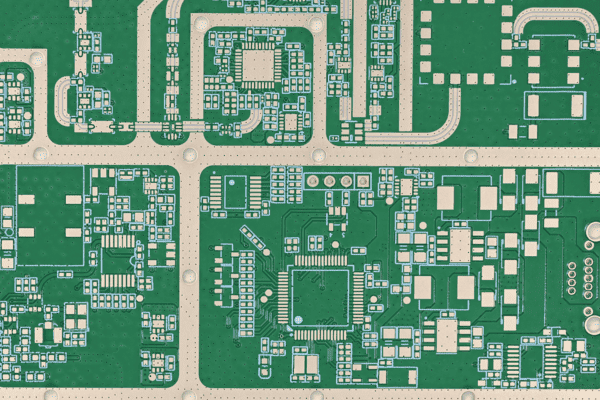
The laminate premium is only one difference between Rogers and FR-4 pricing. Available thicknesses, bonding materials, panel utilization, process review, and impedance verification can also change the fabrication total. A hybrid construction can use Rogers on the RF layer pair and FR-4 for other circuitry, but its bonding and stackup still need fabricator approval.
For a four-layer 5.8 GHz telemetry module, request all-FR-4, approved hybrid, and all-Rogers quotes against one outline, quantity, finish, and test plan. Compare the same loss and impedance targets. If FR-4 passes, paying for Rogers may not help; if it fails, the cheapest quote is not the lowest-cost route to a working product.
Rogers and FR-4 RF Performance
Rogers materials offer specified dielectric behavior that can make an RF design easier to control. At 10 GHz, RO4003C has a process dielectric constant of 3.38 ± 0.05 and dissipation factor of 0.0027; RO4350B lists 3.48 ± 0.05 and 0.0037. FR-4 is a family of grades, so use the chosen grade's data at the relevant frequency rather than one generic FR-4 number.
Laminate loss is not total channel loss. Copper roughness, trace length, transitions, connectors, and solder mask matter too. In a published 10GBASE-T test jig using RO4350B between a CAT6A jack and SMA connectors, the team prototyped the launch taper because the required 50-ohm trace width changed from its FR-4 layout. Switching material therefore calls for a new impedance calculation and layout review.
| Property | Standard FR-4 | RO4003C / RO4350B |
|---|---|---|
| Dk at 10 GHz | Depends on exact formulation | 3.38 ± 0.05 / 3.48 ± 0.05 |
| Df at 10 GHz | Depends on exact formulation | 0.0027 / 0.0037 |
| Best fit | General circuitry when RF budget allows | Low-loss RF paths with defined targets |
When Rogers Earns Its Cost
Use Rogers when a modeled or measured FR-4 channel cannot meet loss, phase, or impedance limits with practical routing. Long antenna feeds, filters, or sensitive receiver paths are candidates; a short 2.4 GHz trace may be fine on a suitable FR-4 grade. Frequency alone is not the decision rule.
For the telemetry module, place the most demanding RF path on the candidate Rogers layers, then verify the proposed hybrid stackup with the fabricator. Measure a prototype against the original electrical limits before committing to volume.
RF PCB Cost Breakdown by Quote Line
An RF PCB cost breakdown should show which charges are fixed and which scale with each accepted board. Request the following lines separately; a low bare-board figure cannot answer the full build cost.
Material and fabrication cover laminate, bondply, copper, imaging, drilling, plating, finish, and bare-board electrical test. RF verification may add impedance coupons, sample measurements, or a dedicated fixture. If the board is populated, add components, stencil and placement setup, soldering, inspection, functional test, and freight.
Use this unit-cost check: total delivered order cost divided by accepted assemblies. Confirm whether scrap allowance, tooling, taxes, and shipping are already included so they are not counted twice. A rush schedule or unusual panel size can change the total without changing the circuit.
Effective RF PCB Cost Optimization
The safest savings come from changing specifications that do not protect the RF margin. Work through these decisions before asking for a lower price.
1. Agree on available core and bondply thicknesses before final routing. Calculate impedance for that approved stackup instead of forcing a custom thickness later.
2. Shorten sensitive paths and control transitions. If fewer layers need low-loss material, quote a qualified hybrid build.
3. Keep standard drill sizes and finishes where the RF launch, assembly process, and reliability target permit. Remove a special process only after documenting its purpose.
4. Quote prototype and production volumes separately. Larger orders spread setup, but a revised design can turn surplus boards into scrap. Compare delivered cost and acceptance scope, not only unit price.
Conclusion
A useful RF PCB cost breakdown connects each added charge to a measurable electrical or manufacturing need. Send PCBgogo your Gerbers, stackup, impedance and loss targets, quantity, and test plan for comparable FR-4, hybrid, or Rogers quotes.
PCBgogo - Reliable, High-Quality PCB Manufacturing
PCBgogo is a one-stop PCB and PCBA manufacturing factory, helping you save time and costs while ensuring consistent, reliable quality.
Get a Free Quote >
FAQ
What usually costs the most in an RF PCB?
The answer depends on the design: specialty laminate and stackup may dominate a bare board, while components and placement can dominate an assembly. Ask for material, fabrication, RF verification, and assembly as separate quote lines.
When is a Rogers laminate worth its premium?
Rogers earns its premium when FR-4 misses a measured electrical target or requires impractical geometry. Test an approved hybrid option when only part of the board needs low-loss material.
What should I send for an RF PCB quote?
Provide Gerbers, drill files, drawing, proposed stackup, exact material callouts, impedance table, quantity, finish, and test requirements. Add a BOM and placement data if you need assembly pricing.