日本語
日本語
 한국어
한국어

Bead Blasting Guide: Finish, Media and Design Tips
QUICK ANSWER Bead blasting is an abrasive finishing process that propels spherical media, commonly glass beads, at a part to create a uniform matte or satin texture. It can soften machining marks, clean surfaces, and prepare selected parts for later finishing, but media, pressure, masking, and cosmetic standards must be specified to protect dimensions and achieve repeatable results.
What Is Bead Blasting and How Does It Work?
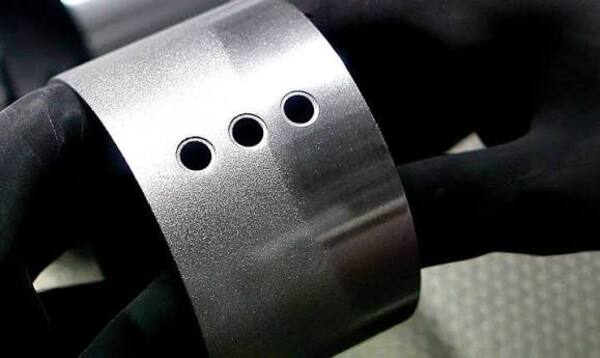
Bead blasting is a form of abrasive media blasting in which compressed air accelerates rounded particles toward a workpiece. Each impact makes a tiny, shallow dimple rather than the sharper cut produced by angular grit. Thousands of overlapping impacts scatter light and replace directional tool marks with a more even matte or satin appearance.
A typical workflow cleans the machined part, masks protected features, selects media and pressure, blasts with controlled nozzle movement, then removes residue and inspects the result. Usually performed in an enclosed cabinet, the process is not a substitute for correct deburring, dimensional inspection, or corrosion protection.
Fine beads and moderate pressure generally create a smoother visual texture, while coarser media or greater impact energy produces a stronger texture. Material hardness, wall thickness, exposure time, and recycled media condition also affect consistency.
Why Do CNC Parts Need Bead Blasting?
Machined metal parts often retain visible toolpaths, uneven reflections, minor surface inconsistencies, and handling marks. Bead blasting solves these problems by creating a controlled, non-directional matte or satin texture.
Key reasons engineers choose bead blasting include:
Hide machining marks: The uniform texture reduces the visibility of cutter paths and minor cosmetic variations.
Create a premium appearance: A consistent, low-glare finish helps CNC parts look more refined and ready for customer-facing products.
Improve surface consistency: Bead blasting can produce a similar texture across flat surfaces, curves, pockets, and other complex geometries.
Prepare parts for secondary finishing: A controlled blasted surface can provide a uniform visual base before anodizing or another compatible finish.
Reduce fingerprints and glare: Matte surfaces are especially useful for frequently handled components and products used under bright lighting.
Common applications include electronics enclosures, medical equipment housings, control panels, brackets, knobs, automotive components, and other exposed CNC parts.
Achieving a consistent bead blasted finish requires careful control of the media, pressure, nozzle movement, masking, and finishing sequence. PCBgogo coordinates precision CNC machining and bead blasting requirements within one manufacturing workflow, reducing supplier handoffs and helping prevent communication errors.
Before production, the PCBgogo engineering team can review your CAD model, cosmetic surfaces, masking requirements, finish sequence, and tolerance-sensitive features. This helps protect threads, precision bores, sealing faces, bearing fits, and other functional areas while maintaining a consistent bead blast texture from the first prototype through repeat production runs.
Upload your design to PCBgogo for a project-specific CNC manufacturing review and quotation.
Which Bead Blasting Media Should You Choose?
Media selection determines how aggressively the surface changes and whether the finish suits the base material. The word bead is often used loosely, so a drawing or purchase order should identify the actual media rather than relying on finish names alone.
| Media | Typical result | Best fit | Main caution |
|---|---|---|---|
| Glass bead | Bright matte or satin texture | Aluminum and stainless steel cosmetic parts | Can lose cutting action as beads break |
| Ceramic bead | Controlled, durable matte texture | Hard alloys and repeat production | More aggressive settings may affect fine edges |
| Steel shot | Peened metallic texture | Robust steel components | Contamination risk on incompatible alloys |
| Plastic media | Gentle cleaning or coating removal | Delicate parts and molded components | Often less suitable for a premium cosmetic texture |
| Aluminum oxide | Duller, etched matte surface | Fast cleaning and coating preparation | Angular grit removes more material |
For cosmetic aluminum housings, fine glass bead is a practical starting point because it produces an even, low glare finish without the deep cutting action of angular grit. Test it on the actual alloy and geometry before releasing a large batch.
What Benefits and Limitations Matter for CNC Parts?
Bead blasting is most valuable when a part needs visual uniformity across machined faces and complex contours. It reduces contrast between toolpaths and creates a consistent base appearance for enclosures, brackets, controls, and product hardware.
Uniform cosmetics: The multidirectional impact pattern hides light machining variation better than sanding, which can leave visible directional scratches.
Complex geometry: A nozzle can reach curved faces, pockets, and transitions that would be slow to finish by hand, although deep recesses may still receive less exposure.
Surface preparation: Blasting removes light contamination and can support later processing, but coating adhesion depends on the chosen media and the coating supplier's validated preparation method.
Dimensional risk: Threads, bores, sealing faces, bearing seats, sharp edges, thin walls, and laser markings may need masking because exposure can change texture, edge definition, or fit.
No added protection: Glass bead blasting changes texture but does not itself add a corrosion barrier. Aluminum parts commonly need anodizing, conversion coating, paint, or another suitable finish when environmental protection is required.
Bead Blasting vs. Sandblasting, Anodizing, and Powder Coating
The right finish follows the part's appearance, protection, tolerance, and service environment. Bead blasting is a mechanical texture process, while anodizing and powder coating create protective surface layers.
| Process | Visual result | Protection | Choose it when |
|---|---|---|---|
| Bead blasting | Uniform matte or satin | None by itself | You need low glare cosmetics or a controlled base texture |
| Angular abrasive blasting | Rougher, dull matte | None by itself | Fast cleaning, stripping, or strong surface etching matters |
| Anodizing | Clear or colored, matte to glossy | Good for aluminum | Wear, corrosion resistance, or color is required |
| Powder coating | Colored coating with more build | Strong barrier protection | Durability and broad color choice outweigh coating thickness |
A common combination is bead blasting followed by anodizing, but the prefinish texture remains visible and can influence final color and gloss. Approve the combined process on a representative sample rather than approving the blast and coating as unrelated operations.
How Should You Specify a Bead Blasted Finish?
A useful specification controls the visual target and the features that must remain functional. A note that says bead blast all over leaves too many choices and can create variation between prototypes and production.
Define the cosmetic zone: Mark Class A visible surfaces, hidden surfaces, and areas where ordinary handling marks are acceptable. State the viewing direction when appearance changes with orientation.
Name the process variables: Specify media type and a practical grade such as fine, medium, or coarse. If pressure is critical, agree on a validated range with the manufacturer rather than copying a generic value from the internet.
Protect functional features: Call out threads, precision bores, sealing faces, electrical contact areas, bearing fits, identification marks, and datum surfaces that require masking or no blast.
Use an appearance standard: Provide a physical limit sample, an approved first article, or clear photographs under defined lighting. Numeric roughness alone may not predict perceived color, gloss, or mottling.
Control the finish sequence: State whether bead blasting occurs before anodizing, painting, marking, bonding, or assembly. The order can change adhesion, dimensions, color, and contamination risk.
ISO 21920-1:2021 defines how profile surface texture is indicated on technical documentation. Apply an essential Ra or Rz requirement only to the relevant surface and confirm that blasting is compatible. Cosmetic acceptance still needs a visual standard.
What Drives Bead Blasting Quality, Cost, and Lead Time?
Bead blasting cost and lead time are driven mainly by handling and process control. Large surface area, complex masking, deep recesses, multiple cosmetic classes, and small batches increase labor per part.
Part geometry: Thin walls and delicate edges need gentler processing, while deep pockets and narrow passages make uniform coverage harder to verify.
Masking effort: Protecting many threads, bores, or mating faces can take longer than the blasting step itself. Design removable plugs or simple fixtures when practical.
Batch consistency: Fresh and recycled media can behave differently. A controlled recipe, clean equipment, first article approval, and traceable lot practices reduce appearance drift.
Inspection method: Visual inspection needs agreed lighting, distance, angle, and acceptance samples. Functional surfaces may also require dimensional or roughness measurement after finishing.
To reduce cost without weakening the requirement, limit premium cosmetic acceptance to visible faces, standardize one media grade, group compatible parts into batches, and approve a realistic range rather than one idealized photograph.
How PCBgogo Supports CNC Prototypes and Product Builds
A manufacturing partner adds value when finish decisions remain connected to fit, electronics, and delivery. PCBgogo presents CNC machining as a precision prototyping capability and also provides PCB fabrication and assembly for products combining machined hardware and circuit boards.
Prototype to production workflow: We support rapid prototyping plus small and medium volume manufacturing, giving teams a practical path to validate fit and appearance before committing to a larger run.
Engineering review: Submitting the 3D model, controlled drawing, cosmetic zones, masking notes, and an approved sample gives the team the information needed to flag manufacturability or finish conflicts early.
Integrated electronics capability: PCB fabrication, component sourcing, and assembly can be coordinated alongside mechanical prototype needs, reducing revision confusion across an enclosure and the board it contains.
Quality and order visibility: We operate under ISO 9001:2015 and IATF 16949 quality management systems, with online quoting and order tracking available across its manufacturing platform.
For a bead-blasted CNC part, ask PCBgogo to confirm the available media, target texture, masking plan, finishing sequence, tolerance impact, and sample approval process for your specific material and geometry. Ready to turn your design into a finished part? Upload your CAD files to PCBgogo today for a project-specific review and quote.
Conclusion
Bead blasting can turn visible toolpaths into a consistent, product-ready matte finish, but repeatability depends on media, geometry, masking, sequence, and acceptance criteria. Define functional and cosmetic surfaces early, approve a representative sample, and give the manufacturer enough information to control the full finishing workflow.
Frequently Asked Questions About Bead Blasting
Does bead blasting remove metal?
Yes, abrasive impact can remove a small amount of surface material, although spherical glass beads are generally less aggressive than angular grit. Protect close tolerance and functional surfaces instead of assuming the dimensional effect is always negligible.
Can bead blasting damage threads or thin walls?
It can alter thread feel, soften edges, or distort delicate sections when media and pressure are poorly matched. Mask critical features and validate thin parts with a first article.
Is bead blasting the same as sandblasting?
No. Bead blasting typically uses rounded media to peen a smoother satin texture, while traditional sandblasting uses angular mineral particles for faster cutting, cleaning, and etching.
Can bead blasted aluminum be anodized?
Yes, bead blasting is commonly used before aluminum anodizing to establish a uniform matte base. Alloy, media condition, blasting consistency, and anodizing chemistry can all affect the final shade, so approve the complete finish stack together.
How do you inspect a cosmetic bead blasted finish?
Use an approved limit sample or first article under defined lighting, distance, and viewing angle. Also inspect masking boundaries, trapped media, color variation, edge rounding, and any functional dimensions identified on the drawing.